
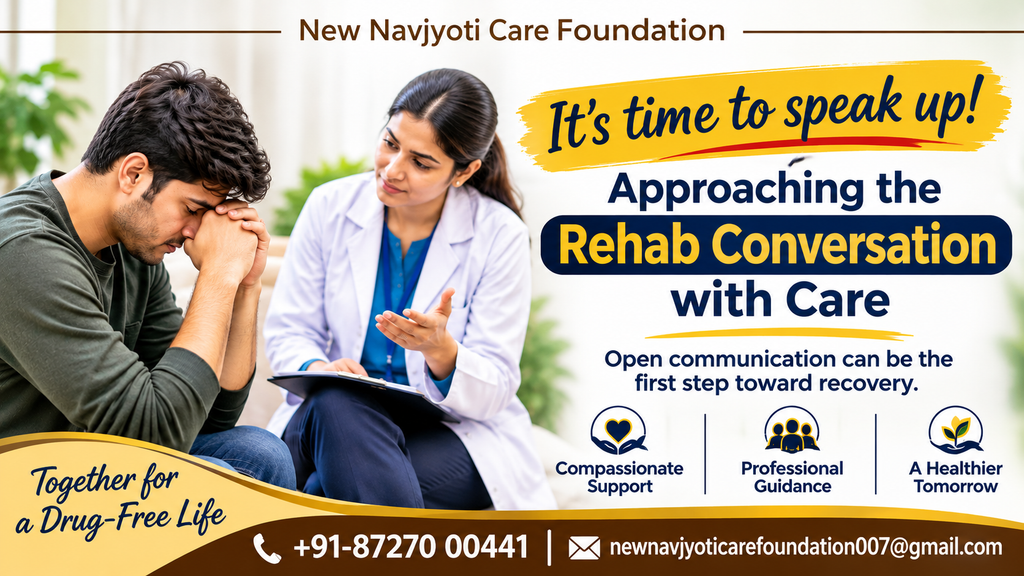
Starting a conversation about rehabilitation is arguably the most painful challenge that any family member or close friend may ever be faced with. But the fear of inciting an angry response, isolating your loved one even more, and making them feel betrayed can very well stop you from saying anything at all.
But saying nothing is no longer an option. And addiction, by its nature, feeds on isolation and secrecy. When you approach this conversation not as a threat but as an opportunity to give a lifeline to the person you care about, everything changes. Visit the best rehabilitation centre in Patiala.
This guide will provide you with a simple, step-by-step guide to start a loving conversation about recovery.
- Change Your Perspective – The Intervention “Ambush”In popular culture, we have been trained to think that an intervention needs to be an ambush. We envision the confrontation with tears, shouting, and a crowd of relatives making the addicted person grab their things right away.A confrontation style of intervention is very ineffective. It triggers the fight-or-flight syndrome, causing the addicted person to defend themselves.Better approach this intervention from the perspective of collaboration. It is not about forcing them to do something, but gently breaking their denial through a mirror of truth and love.
- Timing & Environment Make or Break – Everything about the time and setting for this breakthrough is critical. If you want to set the stage for success for this conversation, it pays to choose an ideal environment:The Sobriety Window: You should never attempt to discuss rehabilitation while the individual is under the influence, high, or suffering from a massive hangover. Instead, choose a time when they have achieved a sobriety window, which is often in the morning, where their minds are clear.
- Neutral Ground: It is essential to find a place that is quiet and free from distractions and interruptions. Do not conduct this discussion in any public place where your loved one may feel embarrassed or at any place that is connected to any previous fight.
- Keep it Intimate: Do not conduct the discussion in a crowd. Just have one or two persons with you that they respect and admire.
- The Strength of “I” Statements – When speaking about an individual who is suffering from the problem of addiction, one finds that it is very easy to slip into being accusatory. Sentences such as, “You always…” and “You have to…” will only serve to make them stop talking immediately. Instead, ensure that everything you say revolves around “I” statements. Talk about your emotions, your perception, and how much you love them.
- Be Ready to Deliver the Solution – A drowning person is not just told to swim; a life jacket is tossed at him or her. Similarly, a person struggling with addiction might be bogged down with the practicalities of life. Even the idea of conducting research on the treatment facilities, verifying whether the insurance is covered, and coordinating the logistics of going into a facility becomes enough to turn them off. Ahead of sitting down with them, prepare:Have at least two or three reputable and licensed rehab centers ready to be mentioned to them.Know what their admission requirements are, how much money they need to spend and how they go about it (holistic treatments or medical treatments, etc.). If required, have an interventionist or an admissions counselor from a trusted facility ready to answer any questions that come up.
- Plan for Deflections and Denials – Your loved one will most probably respond in an aggressive or defensive manner such as “blame game,” denial of the problem, and minimizing the problem as something they could stop anytime if they wanted to. Be ready for this reaction to avoid being thrown off your track.If your loved one responds angrily to you, do not mirror their anger. Use a low and even tone of voice to deliver your boundaries, empathically stating, “I understand that you are angry at me for bringing this up, and it is alright. But because I love you, I can no longer ignore the fact that there is a problem.”If they attempt to make a deal with you and tell you to give them some time (“just let me have one more month to sort myself out”), remind them that addiction is a serious issue and requires professional treatment.
- Provide a Bridge and Not an Ultimatum:- As you conclude the discussion, be sure to outline what lies ahead for them and be clear about the actions you are prepared to take to help. Let them know that choosing to go into rehabilitation requires great courage on their part and is not a sign of defeat or weakness.Tell them how you plan on helping them through it all: “I will take you there; I will handle your apartment; I will be there during family therapy sessions.”
Conclusion
Suggesting that the person whom you love should go into rehabilitation is a courageous step. To take this step, you have to overcome your fear of arguments and provide someone with a chance to survive when he or she does not know how much danger he or she is in. Remember that even if you do not manage to influence his or her first response, you can always create an atmosphere of safety, love, and trust while communicating your concerns to him or her. In this, the best rehabilitation centre in Patiala will prove to be of great help.